
Why Uranium is Quietly Becoming a National Security Issue
Sponsored Content paid for by Eagle Nuclear Energy Corp.
From submarines and aircraft carriers to AI-driven data centers, uranium is becoming central to the infrastructure of the modern economy.
- The United States imports nearly all the uranium fueling its nuclear reactors1 – a strategic vulnerability for a country operating the world’s largest nuclear fleet.
- Electricity demand is rising again, driven by artificial intelligence infrastructure and hyperscale data centers that require enormous amounts of reliable power.2
- Domestic uranium supply is drawing renewed attention as policymakers and energy markets look to strengthen the nuclear fuel supply chain — including companies such as Eagle Nuclear Energy Corp. (NASDAQ: NUCL).
For more than half a century, nuclear energy has powered systems central to both American national security and economic strength.
Uranium fuel powers the reactors that propel the U.S. Navy’s fleet of aircraft carriers and submarines — the largest nuclear-powered naval force in the world.3
“For more than 75 years, the U.S. Naval Nuclear Propulsion Program has powered maritime dominance — harnessing the atom to safely, reliably, and affordably power a global fleet that enables unrivaled responsiveness, endurance, stealth, and warfighting capability.”4
Nuclear power plants across the country also generate nearly one-fifth of America’s electricity, helping stabilize the grid that supports hospitals, manufacturing centers, and critical infrastructure.5
Both systems ultimately depend on secure uranium supply chains. Yet today the United States produces only a small fraction of the uranium it consumes.
In 2023, U.S. nuclear power plants purchased roughly 32 million pounds of imported uranium concentrate, compared with just 0.05 million pounds produced domestically, according to the U.S. Energy Information Administration.6
In other words, the United States produces less than 1% of the uranium fueling its own nuclear reactors.7
For a country operating the world’s largest fleet of nuclear reactors, that imbalance highlights a strategic vulnerability in the nation’s energy infrastructure.
While uranium used in naval reactors is supplied through a separate defense fuel program, the broader civilian nuclear fuel cycle supporting the nation’s nuclear ecosystem remains heavily dependent on foreign supply.8
That reality is drawing renewed attention from policymakers, utilities, and energy markets.
Several companies are exploring ways to expand domestic uranium production or develop next-generation nuclear technologies, including Eagle Nuclear Energy Corp. (NUCL).9
The company controls a sizable uranium resource base in the United States while also developing modular reactor designs intended for distributed power generation. This positions it within several of the shifts now reshaping the nuclear industry.
Electricity demand is rising again after nearly two decades of relatively flat growth, driven partly by artificial intelligence infrastructure and data-center expansion.10 At the same time, governments are reconsidering nuclear power as a reliable source of carbon-free electricity.11
All of which raises a simple but increasingly important question:
If nuclear power expands in the years ahead, where will the fuel come from?
The answer increasingly points to a supply imbalance forming within the global uranium market.
A Uranium Bottleneck Emerging in Plain Sight.
Uranium is increasingly being viewed as a potential bottleneck resource within a sector gaining renewed policy support.
Demand is strengthening, supply remains constrained, and governments are once again promoting nuclear energy as part of long-term energy security strategies. That combination is drawing long-cycle capital back toward the uranium sector.
Global uranium requirements are projected to rise over the next two decades.
Existing reactors are extending their operating lives, while new plants – including advanced reactor designs – move through regulatory pipelines.
The United States currently operates 94 commercial nuclear reactors, which collectively consume roughly 50 million pounds of uranium each year, according to industry estimates.12
Globally, uranium demand could increase between 28% and 51% by 2040, depending on how rapidly nuclear capacity expands.13
Yet supply growth has lagged. After the 2011 Fukushima disaster, uranium prices collapsed.14
Exploration budgets were cut, mine development slowed, and utilities relied heavily on existing inventories rather than new mine supply.
Historically, global uranium mines have supplied only about three-quarters of annual reactor demand, with the remainder coming from stockpiles and other secondary sources.15
As those inventories decline, industry groups such as the World Nuclear Association note that new uranium mines will ultimately be required to meet future reactor demand.16
Global Uranium Demand / Supply Model
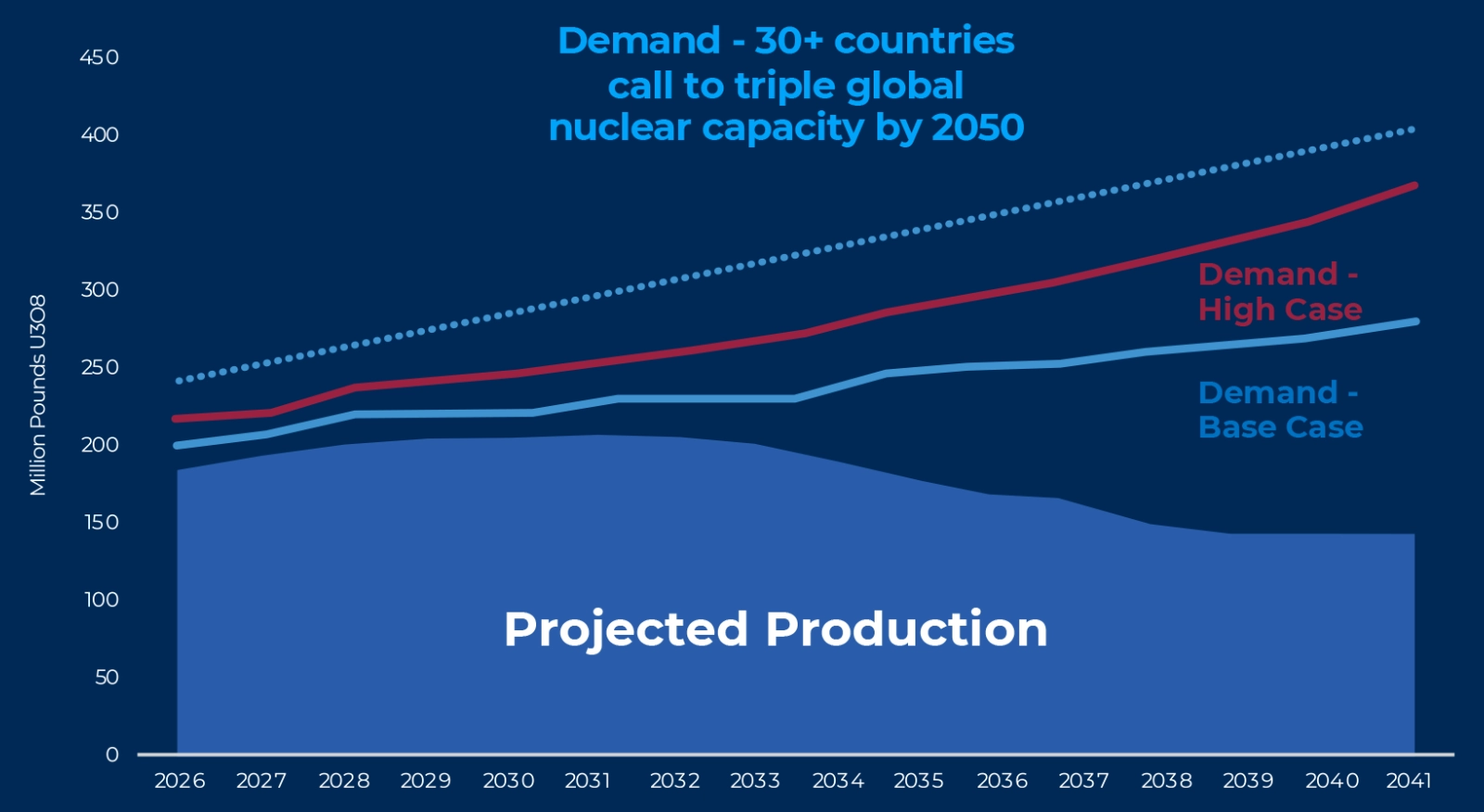
Source: UxC Market Outlook Q4 2025.
Market signals are already beginning to reflect that tightening balance.
Uranium prices surpassed $100 per pound in 2024, the highest level in more than a decade.17 Utilities have also begun returning to long-term contracting markets as concerns grow about securing future fuel supply.18
Industry analysts note that many nuclear utilities still have significant portions of their future fuel requirements uncovered, meaning hundreds of millions of pounds of uranium may need to be secured through new contracts in the coming decade.19
Reuters has reported that utilities are increasingly seeking long-term supply agreements as the market tightens.20
Developing a new uranium mine can take a decade or more from discovery to production, meaning supply often responds slowly when demand rises.21
Companies developing new uranium resources — including Eagle Nuclear Energy Corp. (NUCL)— are positioning themselves within that tightening supply environment.
As nuclear demand rises again, the question becomes increasingly difficult to ignore:
Where will the additional uranium supply come from?
The imbalance becomes even more significant when examining how concentrated global uranium production has become.
The Geopolitics of Uranium Supply
Global uranium production is concentrated in a small group of countries.
Kazakhstan alone accounts for roughly 40% of global mine output, while Canada
and Australia are also major suppliers. Namibia and Uzbekistan contribute additional volumes.22
The United States, by contrast, does not rank among the world’s leading uranium producers.23
Mining is only the first step in the nuclear fuel cycle.
After extraction, uranium must be converted and enriched before it becomes usable reactor fuel.
Historically, those downstream stages have been even more geographically concentrated than mining itself.
In recent years, Russia supplied roughly 20% of the enriched uranium used by U.S. nuclear reactors24, highlighting how dependent parts of the U.S. nuclear fuel infrastructure had become on foreign processing capacity.
That reliance drew far greater scrutiny following Russia’s invasion of Ukraine.

In response, Congress passed the Prohibiting Russian Uranium Imports Act in 2024, restricting imports of Russian nuclear fuel products.25
At the same time, the U.S. Department of Energy committed billions of dollars toward rebuilding domestic enrichment capacity and supporting production of High-Assay Low-Enriched Uranium (HALEU) — a specialized fuel required for many next-generation reactor designs.26
Uranium has also been designated a critical mineral by the U.S. government, reflecting a broader reassessment of nuclear fuel supply chains in Washington.27
Meanwhile, other major powers are expanding nuclear capacity. China is accelerating the construction of dozens of new reactors as part of its long-term energy strategy.28
Taken together, these developments are drawing increased attention to domestic uranium resources and fuel-cycle infrastructure — including projects being developed by companies such as Eagle Nuclear Energy (NUCL).
Yet geopolitics and supply constraints tell only part of the story.
A broader shift in global electricity demand is also pushing nuclear power back toward the center of the global energy conversation.
Washington Signals a Strategic Nuclear Reset
Concerns about uranium supply and nuclear fuel infrastructure are rising on Washington’s strategic agenda as policymakers move to strengthen America’s nuclear energy capabilities.
In recent years, nuclear power has increasingly been viewed not only as a source of low-carbon electricity, but also as a strategic asset supporting both the civilian power grid and the broader nuclear enterprise that underpins U.S. defense capabilities.
As a result, U.S. nuclear policy is entering one of its most ambitious expansion phases in decades.
On May 23, 2025, the White House issued a series of executive orders aimed at accelerating nuclear energy development across the United States.29 The directives focus on reducing regulatory barriers, expanding reactor construction, and strengthening the domestic nuclear fuel supply chain.
Key elements include streamlining reactor approvals and expanding nuclear generating capacity. The directives also invoke the Defense Production Act to support domestic uranium production and restore U.S. leadership in nuclear technology.30
Federal planning documents outline several near-term objectives, including activating advanced or experimental reactors later this decade, uprating existing plants to increase output, and developing additional reactors as part of longer-term grid planning.31/32
Taken together, these initiatives represent one of the most significant shifts in U.S. nuclear policy in decades.
Nuclear Returns to the Policy Agenda
As the U.S. Department of Energy has stated:
“Nuclear energy is critical to achieving energy security and meeting America’s growing electricity demand.”33
The policy momentum reflects a broader reassessment of nuclear power’s role in modern infrastructure.
For much of the past two decades, nuclear energy was often treated as a legacy industry, which slowed new development across many countries.34
Today, the energy landscape looks very different.
Electricity demand is rising again, driven by artificial intelligence infrastructure, semiconductor manufacturing, and other power-intensive technologies.
Meeting that demand will require substantial additions to power generation capacity.
Nuclear power remains one of the few technologies capable of delivering large-scale, reliable, carbon-free electricity.35
More than 440 reactors currently operate worldwide, with dozens more under construction, according to the World Nuclear Association.36
U.S. nuclear plants operate at capacity factors near 90%, generating electricity almost continuously — significantly higher than most other power sources.37
As electricity demand rises and energy security concerns grow, nuclear power is increasingly being reconsidered as a core component of long-term energy infrastructure.
And if nuclear generation expands, the conversation inevitably returns to one key input: uranium fuel.
Rising electricity demand, renewed policy support, and concern about nuclear fuel supply chains are converging — placing uranium and nuclear infrastructure back near the center of long-term energy planning.
Those shifts are also drawing attention to companies positioned within the nuclear supply chain — including firms such as Eagle Nuclear Energy (NUCL).
Electricity Demand Is Rising Again — Driven by AI and Data Centers
For nearly two decades, electricity demand in the United States grew only modestly as efficiency gains offset rising consumption. That trend is now beginning to reverse.
The U.S. Energy Information Administration projects that electricity demand will rise steadily through the remainder of the decade, marking one of the strongest sustained growth periods in more than twenty years.38
One of the primary forces behind that shift is computing.
AI Is Driving a New Surge in Electricity Demand
Artificial intelligence systems, hyperscale data centers, and cloud infrastructure require enormous amounts of electricity.39
That power runs processors, networking equipment, and the cooling systems needed to keep them operating.
Growing Electrical Demand
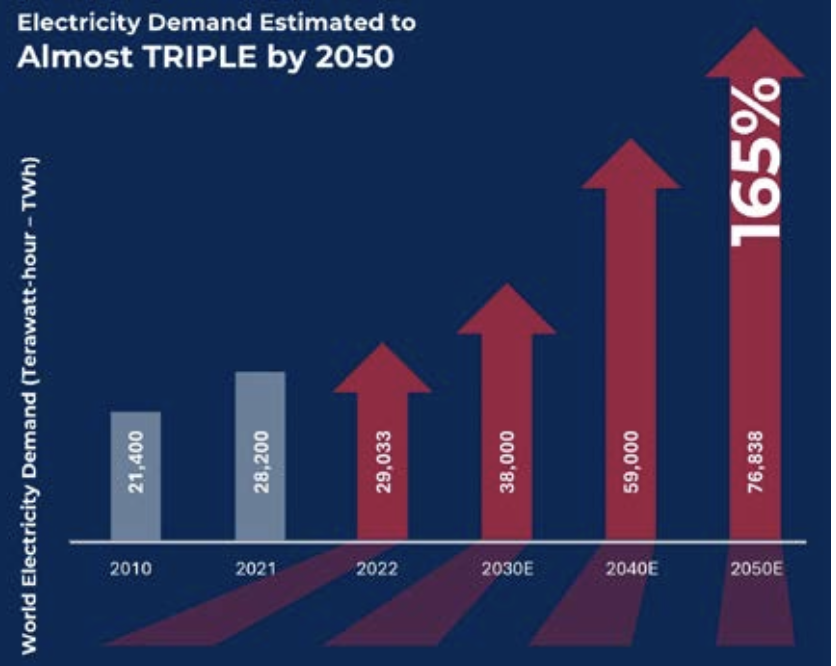
Source: UxC Market Outlook Q4 2023.
The scale of that demand is already becoming visible. According to the International Energy Agency, global data-center electricity consumption reached roughly 415 terawatt-hours in 2024 and could climb to around 945 terawatt-hours by 2030 as artificial-intelligence infrastructure expands.40
The United States is already experiencing the effects of that growth. In 2024, U.S. data centers consumed approximately 183 terawatt-hours of electricity, accounting for more than 4% of total U.S. power demand.41
Meeting that level of demand will require substantial additions to power generation capacity. Utilities, technology companies, and policymakers are already evaluating a range of energy sources — including natural gas, renewable power, and nuclear generation.
Advanced nuclear technologies, particularly Small Modular Reactors (SMRs), are increasingly part of those discussions because they offer the potential for reliable, carbon-free electricity located close to energy-intensive infrastructure.
Why Small Modular Reactors Are Gaining Attention42
The next phase of nuclear energy may look very different from the last.
Traditional nuclear plants were designed as massive infrastructure projects capable of generating enormous amounts of electricity. But they also require long construction timelines and large upfront capital investments.
Small Modular Reactors (SMRs) aim to change that model.
Rather than building a single large facility, SMRs are designed as smaller modular units.
These reactors can be factory-manufactured and assembled on site.
Their smaller size allows reactors to be deployed in a wider range of locations.
These include industrial sites, data-center clusters, remote infrastructure, and regions where large nuclear plants would be impractical.43
44More than 80 SMR designs are currently under development worldwide, according to the International Atomic Energy Agency, reflecting growing interest from governments, utilities, and private industry.45
For investors, the question is increasingly which companies may be positioned within the emerging nuclear supply chain.
And that brings the discussion back to a central question:
Where will the uranium come from?
That strategic question is now drawing renewed attention to domestic uranium supply — and the companies working to develop it.
For companies operating in that segment of the nuclear fuel cycle — including firms such as Eagle Nuclear Energy (NUCL) — the shift is beginning to attract renewed investor interest.
Where Eagle Nuclear Fits in the Emerging Nuclear Supply Chain
As policymakers and energy markets focus on strengthening nuclear fuel supply chains, attention is increasingly turning to companies positioned within the emerging nuclear ecosystem.
Eagle Nuclear Energy (NUCL) is attempting to operate across two parts of that system: uranium fuel supply and next-generation reactor technology.46
Most companies in the nuclear industry operate within a single segment of the value chain. Uranium developers focus on mineral resources, reactor designers concentrate on engineering and licensing, and utilities operate nuclear power plants.
Eagle’s strategy spans two parts of that ecosystem — developing domestic uranium resources and advancing modular reactor technologies designed for distributed power generation.
Alongside its uranium resource base — anchored by the Aurora flagship deposit — the company is also currently developing proprietary reactor designs.
Currently in the design stage, Eagle is developing small modular reactor technologies to support future power demand. These designs are intended to support emerging applications such as industrial facilities, remote infrastructure, and data-center power systems.
The SLLIM Small Modular Reactor (SMR) is intended for scalable electricity generation in industrial regions and utility grids. Its modular architecture allows multiple units to be deployed together to support large energy users.47
The VSLLIM Micro-Modular Reactor is designed for smaller deployments, including remote communities, defense installations, and mining operations. The liquid-met-al-cooled fast-reactor concept is expected to generate roughly 3.3 megawatts of electricity with a projected six-year refueling cycle.48
This dual approach places the company at the intersection of two critical parts of the nuclear energy system: fuel supply and power generation technology.
Together, these initiatives link domestic uranium resources with distributed nuclear energy technologies.
That strategy ultimately rests on the foundation of the company’s portfolio: its domestic uranium resource base.
Inside Eagle Nuclear Energy’s Uranium Assets
Understanding Eagle Nuclear Energy’s strategy begins with its uranium resource base.
If nuclear energy enters a new phase of growth, the conversation ultimately returns to fuel supply.
Yet today the United States produces only a small fraction of the uranium consumed by its nuclear fleet.
For decades, that imbalance attracted little attention. Global supply chains were stable, and foreign producers supplied utilities with reliable fuel.
But the geopolitical landscape surrounding energy supply has changed.
Governments are increasingly reassessing the origins of critical materials and the extent to which vital infrastructure depends on external suppliers. In that environment, the location and scale of domestic uranium resources take on greater strategic importance.
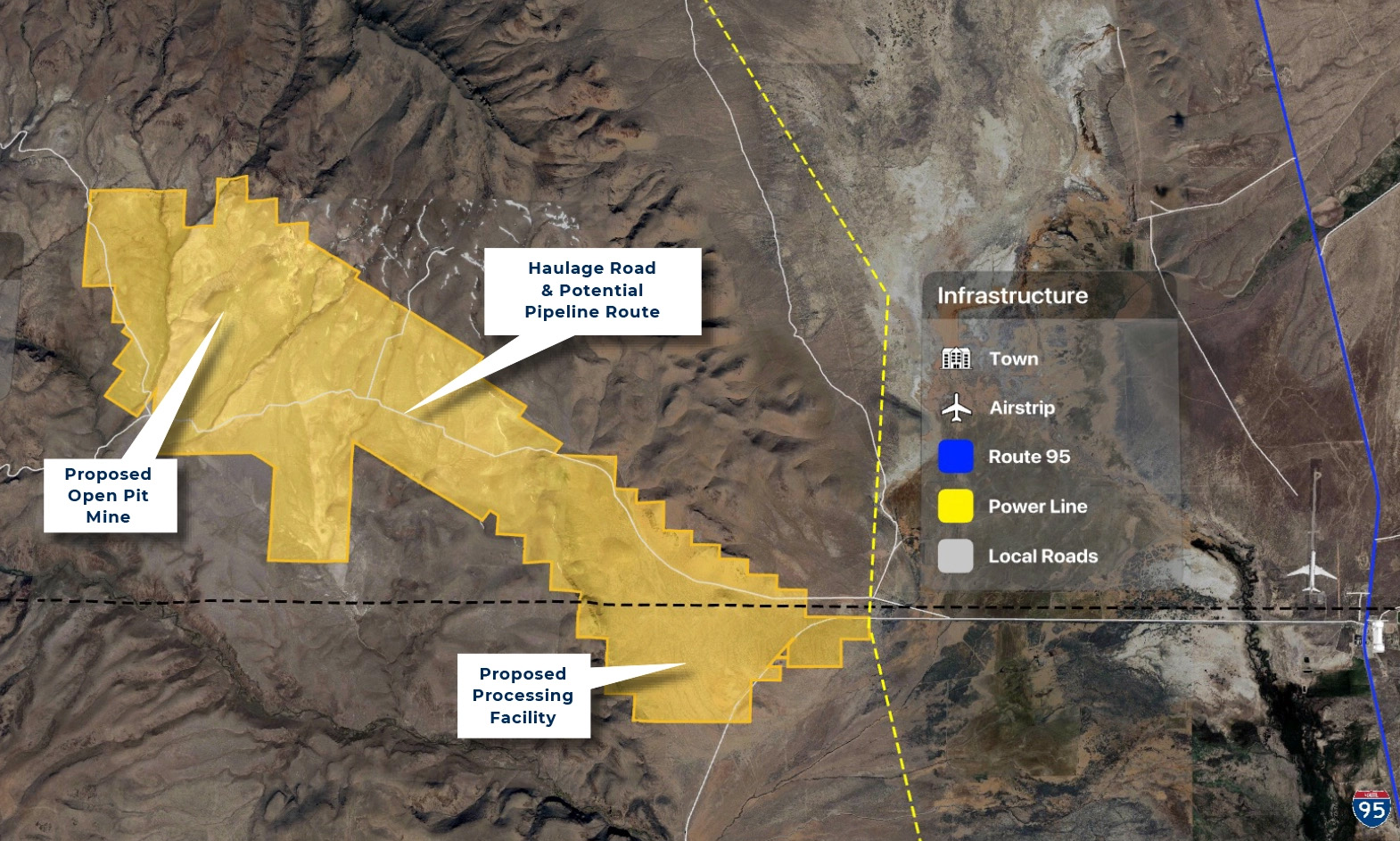
That shift brings the discussion to Eagle Nuclear Energy (NUCL) uranium portfolio.49
The company’s holdings are anchored by the Aurora project along the Oregon–Nevada border, with additional potential in the nearby Cordex deposit.
Together, these projects represent one of the largest undeveloped uranium resource bases currently defined in the United States.
At the center of that portfolio is the Aurora deposit.
Aurora: One of the Largest Undeveloped Uranium Resources in the United States50
Aurora represents the cornerstone of Eagle Nuclear Energy (NUCL) uranium portfolio. The Aurora Project is an advanced-stage uranium project in Oregon currently advancing through development and permitting-related work.
At a time when policymakers and utilities are increasingly focused on securing reliable domestic uranium
supply, deposits of meaningful scale have become strategically significant.
According to the company’s S-K 1300 technical report, the project contains approximately:
• 32.75 million pounds of uranium in the indicated category
• 4.98 million pounds in the inferred category
The Aurora deposit is one of the largest undeveloped uranium deposits currently identified in the United States.
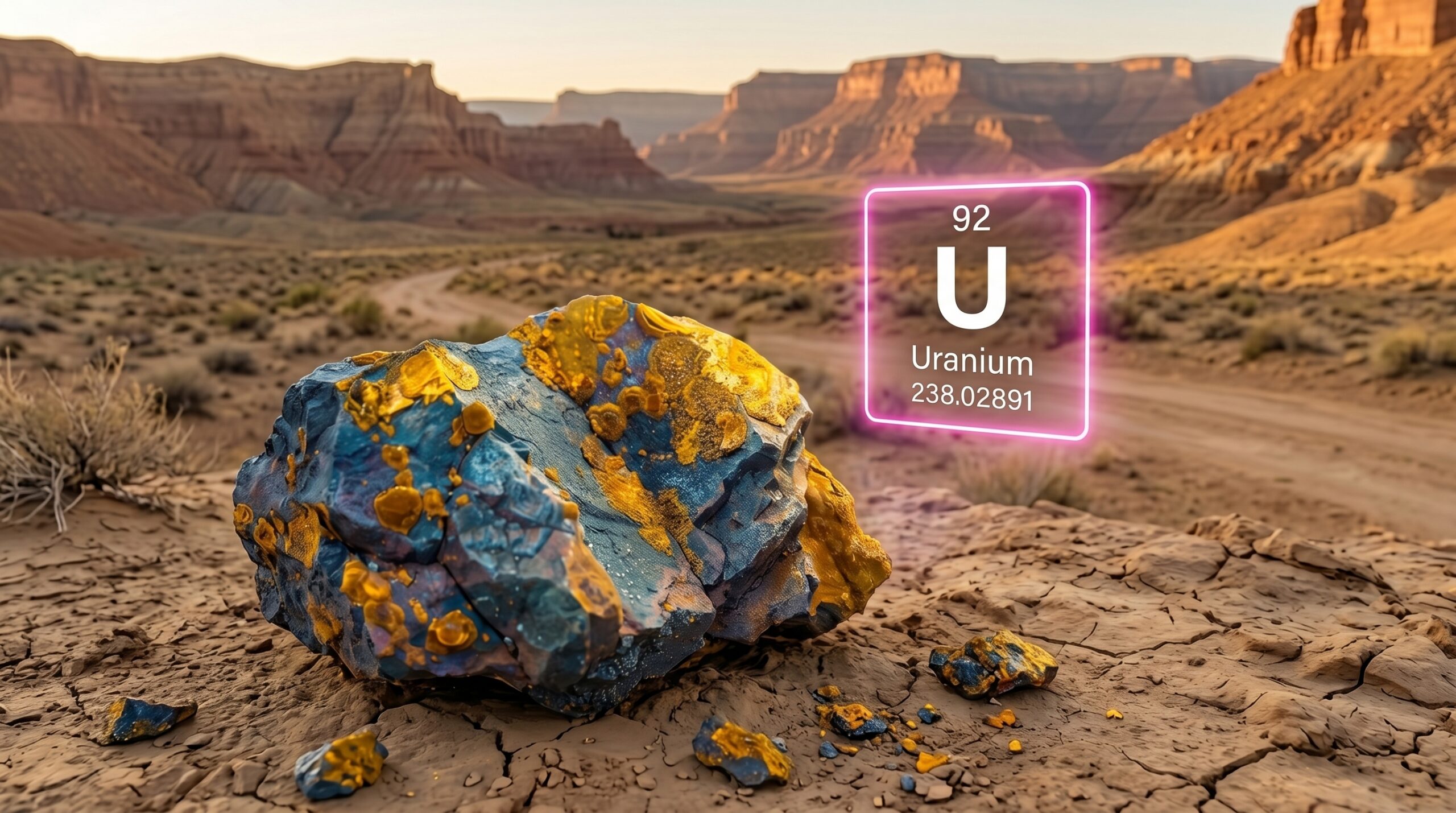
Under the SEC’s S-K 1300 reporting framework, indicated resources are supported by sufficient drilling to estimate grade and tonnage with reasonable confidence, while inferred resources carry greater geological uncertainty and may be upgraded with additional drilling.
Aurora’s resource estimate is supported by more than 500 historical drill holes.
Together, they provide a substantial geological dataset across the deposit.
Drilling indicates the uranium occurs within relatively flat, tabular sedimentary layers. In some areas, the mineralization lies only a few dozen feet below surface, a geometry that could allow for conventional open-pit mining if development proceeds.
Metallurgical testing has produced encouraging early results, with uranium recovery rates in the high-80% range and lower reagent consumption and processing times than earlier assumptions. Additional engineering studies will be required to refine the processing flowsheet and evaluate project economics.
Aurora also sits within a broader mineralized district, suggesting potential exploration upside beyond the currently defined resource.
Technical work on the project has included evaluation and engineering support from BBA USA, an international consulting firm specializing in mining and energy infrastructure.
The company has indicated that additional drilling and technical studies are planned to support a future pre-feasibility study.
Cordex: Expansion Potential Within the District51
Adjacent to the Aurora Deposit lies the Cordex deposit, which Eagle Nuclear Energy (NUCL) considers part of the same broader mineralized district.
Cordex contains historical uranium mineralization and exploration potential. Early geological work suggests Cordex could host additional pounds of uranium potential, supported by over 100 historical drill holes.
While the deposit is less defined than Aurora and will require additional drilling to confirm its full extent, it highlights the broader exploration potential across the district.
Because Cordex is adjacent to the Aurora project, the two deposits could potentially share infrastructure if development proceeds — an approach sometimes used in district-scale mining systems to improve overall project efficiency.
Cordex represents exploration upside adjacent to the Aurora Project and may expand the resource base.
Leadership with Mining and Nuclear Experience
Developing large mineral projects can take many years, making experienced leadership an important factor for investors evaluating early-stage mining companies.
Eagle Nuclear Energy (NUCL) is led by Chief Executive Officer Mark Mukhija, a professional mining engineer with nearly two decades of experience in the global mining industry.53
Prior to founding Eagle, Mr. Mukhija worked with major mining companies including BHP, Barrick, and Teck Resources, gaining experience in project development, operations, and mining technology.
The company’s broader leadership team includes executives focused on project development, finance, operations, and reactor licensing.53
Together, the group reflects Eagle’s dual strategy of advancing domestic uranium resources while developing next-generation nuclear technologies.
So it’s little wonder that, as interest in nuclear energy and uranium supply grows, companies such as Eagle Nuclear Energy (NUCL) are beginning to appear on the radar of investors tracking the sector.

CEO & Director: Mark Mukhija, P. Eng
Forces Reshaping the Nuclear Market — And Where Eagle Fits
Governments are reconsidering nuclear power’s role in energy security and carbon reduction. And electricity demand is rising again after years of stagnation — driven by artificial intelligence infrastructure, semiconductor manufacturing, and electrified industrial systems.
At the same time, Small Modular Reactor (SMR) technologies are advancing, potentially allowing nuclear generation to expand into locations and applications that were previously difficult to serve.
These developments are unfolding as uranium supply remains highly concentrated outside the United States, prompting policymakers to reassess the security of nuclear fuel supply chains.
As nuclear capacity expands, analysts increasingly expect that additional uranium supply will be required to support future reactor demand.
For the United States, that raises a fundamental question:
Where will future domestic uranium supply come from?
Most companies in the nuclear industry operate within a single segment of the value chain — uranium mining, reactor design, or power generation.
Eagle Nuclear Energy (NUCL) is attempting to operate across more than one layer of that ecosystem.
The company controls a domestic uranium resource base while also developing modular reactor technology for distributed power generation, positioning it within several of the trends reshaping the nuclear sector.
As the industry evolves, the question for many investors is no longer simply whether nuclear power will expand.
It is which companies may be positioned within the emerging nuclear supply chain.
Against that backdrop, several characteristics help explain why Eagle Nuclear Energy (NUCL) is beginning to appear on more investor watchlists.
Five Factors Drawing Investor Attention to Eagle Nuclear Energy
Several structural forces are drawing renewed attention to companies operating within the nuclear sector.
1
A Large Domestic Uranium Resource54
Eagle’s Aurora project contains 32.75mm LBS Indicated, and 4.98mm LBS Inferred, according to the company’s S-K 1300 technical report — making it one of the largest undeveloped uranium deposits currently identified in the United States.

2
District-Scale Expansion Potential55
Nearby exploration targets such as the Cordex deposit could expand the company’s overall resource base as additional drilling progresses.

3
Exposure to Multiple Parts of the Nuclear Value Chain
Unlike many companies that focus solely on uranium mining or reactor development, Eagle is pursuing both uranium resource development and modular reactor technology.56

4
Emerging Reactor Technologies57
Small Modular Reactors (SMRs) are attracting growing interest as potential sources of reliable, carbon-free electricity for applications ranging from industrial facilities to data centers and remote infrastructure.

5
A Strategic Moment for Domestic Uranium
The United States still imports the vast majority of the uranium used by its nuclear fleet, even as policymakers move to expand nuclear power and strengthen domestic fuel supply chains.

Investor Perspective
These developments help explain why uranium and nuclear infrastructure are returning to the investment conversation.
Electricity demand is rising again.
Governments are reconsidering nuclear energy as part of long-term energy security strategies.
And the uranium supply chain remains heavily dependent on foreign production.
As a result, many investors are beginning to re-examine companies positioned within the evolving nuclear sector.
One example is Eagle Nuclear Energy (NUCL), which is pursuing a strategy that combines domestic uranium resources with next-generation nuclear technology.
For investors watching the sector, the implications of these shifts are becoming increasingly difficult to ignore.
The Bottom Line
Energy transitions rarely happen overnight. But when several powerful forces begin moving in the same direction — rising electricity demand, supportive government policy, and constrained fuel supply — entire industries can change.
Nuclear energy may be approaching one of those moments.
If that happens, attention will extend beyond reactors and power plants to something less visible but equally important: the uranium required to fuel them.
And for the United States, that question increasingly overlaps with both energy security and national security.
Companies developing American uranium resources, including Eagle Nuclear Energy (NUCL), are positioning themselves within that evolving landscape.
Through its combination of domestic uranium assets and modular reactor technology, the company is pursuing an integrated approach to nuclear energy — powering America from the ground to the grid.
A Final Word on Risk
Investing in emerging energy technologies and natural-resource companies involves significant risk.
Uranium projects often require long development timelines and must navigate complex permitting processes, engineering challenges, and fluctuating commodity prices. Early-stage resource developers in particular can be highly speculative investments.
Share prices may be volatile, and projects that appear promising may ultimately take years to advance — or may never reach production.
Investors should conduct independent research and avoid committing capital they cannot afford to lose. As with any investment, diversification and careful risk management remain essential.
Readers interested in learning more about Eagle Nuclear Energy (NUCL) can visit the company’s website for additional technical information and project updates.
Sources
- 1. https://www.eia.gov/uranium/marketing/
- 2. https://www.iea.org/reports/electricity-2024
- 3. https://www.energy.gov/nnsa/naval-nuclear-propulsion-program
- 4. https://www.energy.gov/nnsa/naval-nuclear-propulsion-program
- 5. https://www.eia.gov/uranium/marketing/
- 6. https://www.eia.gov/uranium/marketing/
- 7. https://www.eia.gov/uranium/marketing/
- 8. https://energy.stanford.edu/news/us-nuclear-energy-future-fuel-supply-must-not-be-overlooked
- 9. https://eaglenuclear.com/
- 10. https://www.iea.org/reports/electricity-2024
- 11. https://www.energy.gov/ne/articles/us-sets-targets-triple-nuclear-energy-capacity-2050
- 12. https://world-nuclear.org/information-library/country-profiles/countries-t-z/usa-nuclear-power.aspx
- 13. https://www.reuters.com/business/energy/uranium-demand-set-rise-2040-wna-2023-09-07/
- 14. https://word-nuclear.org/
- 15. https://world-nuclear.org/information-library/nuclear-fuel-cycle/uranium-resources/supply-of-uranium.aspx
- 16. https://www.ft.com/content/0d6cb34e-4fda-4182-a319-11bae1917141
- 17. https://tradingeconomics.com/commodity/uranium
- 18. https://thedeepdive.ca/uranium-utilities-return-to-market-after-year-of-delayed-contracting/
- 19. https://www.cameco.com/invest/markets/supply-demand
- 20. https://www.reuters.com/markets/commodities/uranium-contract-prices-soar-uncertain-supply-ai-led-powe r-demand-2024-07-29/
- 21. https://www.cruxinvestor.com/posts/nuclear-capacity-set-to-double-mine-development-timelines-extend-to -20-years-the-uranium-investment-window-widens#:~:text=So%20in%20this%20report%2C%20we,enco mpass%20the%20entire%20fuel%20cycle
- 22. https://world-nuclear.org/information-library/nuclear-fuel-cycle/uranium-resources/supply-of-uranium
- 23. https://www.eia.gov/uranium/production/
- 24. https://www.eia.gov/todayinenergy/detail.php?id=61545
- 25. https://www.whitehouse.gov/briefing-room/statements-releases/2024/05/13
- 26. https://www.energy.gov/ne/articles/doe-announces-advanced-nuclear-fuel-investments
- 27. https://www.energy.gov/cmm/critical-minerals
- 28. https://www.nuclearbusiness-platform.com/media/insights/chinas-nuclear-power-program-a-blueprint-for-g lobal-competitiveness
- 29. https://www.whitehouse.gov/briefing-room/presidential-actions/
- 30. https://www.whitehouse.gov/briefing-room/presidential-actions/
- 31. https://www.energy.gov/ne/advanced-reactor-demonstration-program
- 32. https://www.nrc.gov/reactors/operating/licensing/power-uprates.html
- 33. https://www.energy.gov/ne/nuclear-energy
- 34. https://world-nuclear.org/information-library/current-and-future-generation/nuclear-power-in-the-world-today
- 35. https://www.iea.org/reports/nuclear-power-and-secure-energy-transitions
- 36. https://world-nuclear.org/information-library/current-and-future-generation/nuclear-power-in-the-world-today
- 37. https://www.eia.gov/energyexplained/nuclear/us-nuclear-industry.php
- 38. https://www.eia.gov/outlooks/steo/
- 39. https://www.iea.org/news/ai-is-set-to-drive-surging-electricity-demand-from-data-centres-while-offering-the -potential-to-transform-how-the-energy-sector-works
- 40. https://www.iea.org/reports/electricity-2024
- 41. https://www.iea.org/reports/electricity-2024
- 42. https://www.energy.gov/ne/articles/what-are-small-modular-reactors-smrs
- 43. https://www.iaea.org/publications/13567
- 44. https://www.iea.org/reports/electricity-2024
- 45. https://www.iaea.org/topics/small-modular-reactors
- 46. https://eaglenuclear.com/projects/eagle-smr-nuclear-technology/
- 47. https://eaglenuclear.com/projects/eagle-smr-nuclear-technology/
- 48. https://eaglenuclear.com/projects/eagle-smr-nuclear-technology/
- 49. https://eaglenuclear.com/projects/aurora-uranium-project/
- 50. https://eaglenuclear.com/projects/aurora-uranium-project/
- 51. https://eaglenuclear.com/market/
- 52. https://www.globenewswire.com/news-release/2026/02/25/3244602/0/en/Eagle-Nuclear-Energy-Corp-Co mmences-Trading-on-Nasdaq-Under-Ticker-Symbol-NUCL.html
- 53. https://finance.yahoo.com/news/eagle-energy-metals-strengthens-leadership-133000292.html?
- 54. https://eaglenuclear.com/projects/aurora-uranium-project/
- 55. https://ir.eaglenuclear.com/static-files/837a64fe-a778-4209-9239-313d77a3aa0f
- 56. https://eaglenuclear.com/
- 57. https://eaglenuclear.com/projects/eagle-smr-nuclear-technology/
- 57. https://eaglenuclear.com/projects/eagle-smr-nuclear-technology/
IMPORTANT NOTICE AND DISCLAIMER
This PUBLICATION is an issuer-paid advertisement. This paid advertisement includes a stock profile of Eagle Nuclear Energy Corp. (NUCL). To enhance public awareness of NUCL and its securities, the issuer has provided Promethean Marketing, Inc. (“Promethean”), through a third-party advertiser, with a total budget of approximately [Insert Amount] (insert amount) to cover the costs associated with this advertisement for a period beginning [insert date] and currently set to end [insert date]. The website hosting this advertisement, Investing Letter, is owned by Promethean. Investing Letter has not been paid to host this advertisement. As a result of this advertisement, Investing Letter may receive advertising revenue from new advertisers and collect email addresses from readers that it may be able to monetize. Promethean will retain any excess sums after all expenses are paid. As of the date this advertisement is posted to the Investing Letter website, some or all of Promethean, Investing Letter, or the third-party advertiser being utilized by NUCL to provide Promethean with the above described advertising budget, and any of their respective officers, principals, or affiliates (as defined in the Securities Act of 1933, as amended, and Rule 501(b) promulgated thereunder) may hold the securities of NUCL and may sell those shares during the course of this advertising campaign. This advertisement may increase investor and market awareness, which may result in an increased number of shareholders owning and trading the securities of NUCL, increased trading volume, and possibly an increased share price of NUCL’s securities, which may or may not be temporary and decrease once the advertising campaign has ended. To more fully understand the Investing Letter website or service, please review its full Disclaimer and Disclosure Policy located at https://investingletter.com/legal-disclaimer/.
